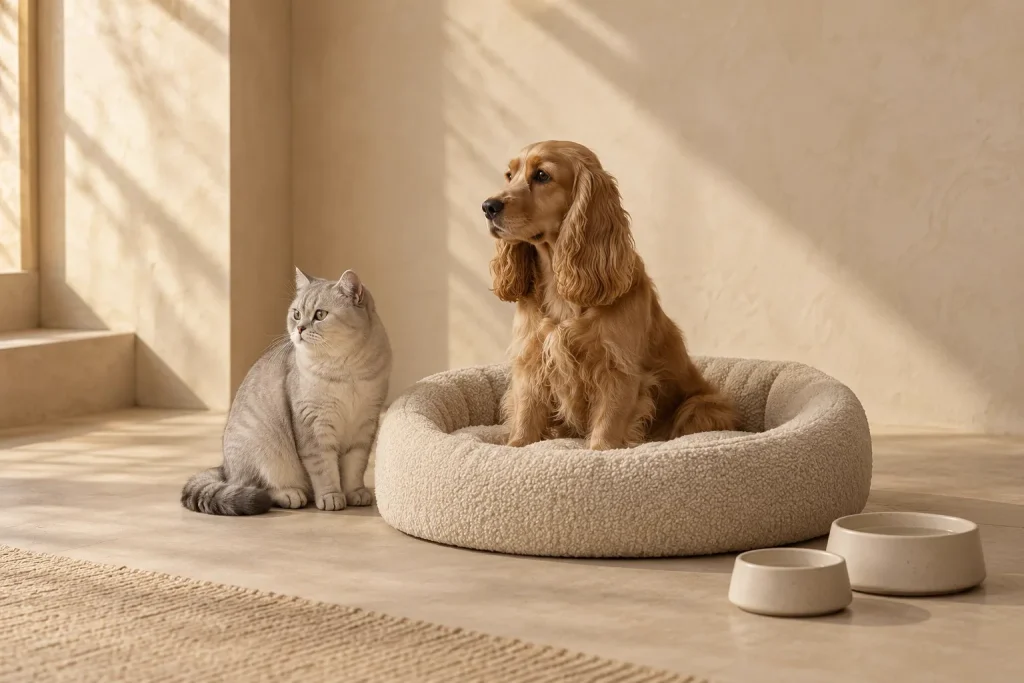
How to Buy Pet Supplies Wholesale from China
Buying pet supplies wholesale from China is not complicated. Buying the right products, at a total cost that still leaves you a margin after freight, is where first orders usually go wrong. This guide is about the decisions behind a good order — what to check, what to question, and what to avoid. For the ordering process itself, step by step, see our Wholesale Ordering Guide.
Start with your shelf, not with a catalog
The most common first-order mistake is choosing products because they look good in photos rather than because they fit your customers, your price points, and your shelf space. A small pet shop or online store usually does better with a tight, coherent range than with a little of everything.
Think about how each category behaves in your business. Sleep & Rest products such as beds are bulky and take storage and shelf room. Dine & Drink items — bowls, feeders, mats — are compact and easier to ship and store. Walk & Wear products come in size runs, so one style means several variants to stock. Scratch & Climb pieces are mostly for cats and often ship as larger cartons, while Play & Explore toys are small, light, and easy to add to an order to round it out. Carry & Travel products sit at higher price points and sell on design and detail. Dress & Style pieces are apparel, so size runs and the season decide how they move.
A balanced first shortlist usually mixes a few compact, fast-moving items with a smaller number of statement pieces — not a container's worth of one untested product.
Read the price properly: EXW is not your landed cost
On Pawrenzo product pages, prices are shown as USD EXW reference tiers for 100+, 200+ and 500+ units. Two things about that matter more than the number itself.
First, EXW means the price covers the goods, not the journey. International freight is excluded and is quoted separately for each order, because it depends on what you buy, how it packs, and where it is going. Comparing an EXW price against another supplier's delivered price is comparing two different things — a classic way to think you found a bargain and discover the difference at the freight stage.
Second, freight behaves differently by product type. Light but bulky goods — beds, cat trees, carriers — take up carton volume, and on such products freight can rival the cost of the goods themselves. Compact, dense goods travel much more efficiently. So the right question is never just "what is the unit price?" but "what does one unit cost me, delivered, ready to sell?" Ask for the freight options to your destination before you judge your margin, not after you have committed.
The website tiers are reference prices. Your formal quotation confirms the exact unit prices for your quantities and variants before you pay anything.
Check specifications like a buyer, not a browser
Product photos show you what a product looks like. Specifications tell you what you are actually buying: dimensions, materials, capacity, and the variant list. Read them the way your customers will experience the product.
A few habits separate smooth orders from disappointing ones. Measure sizes against your market's expectations — a bed that looks generous in a photo may be sized for small breeds only. For harnesses and wearables, look at the full size run and each size's measurements, not just "S/M/L". For anything where a number drives the buying decision — bowl capacity, carrier dimensions, scratcher height — confirm that number in your inquiry if it is not stated, instead of assuming the photo tells the story.
If a specification you need is missing, ask. A short question before ordering is free; a wrong assumption is not.
Samples are your cheapest quality control
Samples are available for the products you shortlist, and ordering them before any bulk order is the single most effective way to protect yourself. Sample and courier costs are borne by the buyer — and yes, courier on a single parcel can feel expensive relative to one item. Compare it honestly with the alternative: discovering a material, size, or finish problem across a few hundred units.
A sample lets you check the things a page cannot prove: how the material actually feels, how stitching and fastenings are finished, whether the real size matches the stated size, and whether the color matches the photos. If something is not right, that conversation happens before your bulk order, when it is easy to fix or walk away.
Write inquiries that get usable quotes
A supplier can only quote what you specify. Inquiries that say "best price please" get vague answers, because there is nothing concrete to price. Inquiries that list the products and variants you want, the quantity per item, and your destination country get a quotation you can actually make a decision on.
At Pawrenzo, we reply to inquiries within one business day. You can send yours from any product page, through the contact page, or on WhatsApp — the more specific it is, the more useful the reply.
A sensible first order
Put together, a sound first order looks like this: a focused shortlist that fits your shelf, samples checked before bulk, specifications confirmed rather than assumed, freight priced before margins are judged, and every final term — unit prices, minimum per style, packaging, shipping — confirmed in writing in the formal quotation before payment. Regular minimum order at Pawrenzo starts from 100 pcs per style, with final terms for your items confirmed in the quotation.
None of this is difficult. It is simply the difference between buying photos and buying products. Browse the full catalog with your shelf in mind, and send us a specific inquiry when you are ready.