How to Vet a Pet-Supplies Factory in China Before You Wire Any Money
Sending an international wire transfer (T/T) to an overseas supplier for the first time is the highest-stress moment for any independent pet store owner, boutique brand, or regional distributor. When you are sourcing across borders, a polished website or a persuasive sales catalog does not guarantee who is actually on the other end of the invoice.
In the pet supplies trade, buyers generally run into two hidden traps: working with unverified middlemen who stack invisible markups onto every unit without controlling production quality, or wiring a deposit to a workshop that cannot deliver the consistency shown in studio photos. Once your funds clear across international banking rails, your leverage drops to near zero.
Vetting a factory in China does not require flying to Guangzhou or paying thousands of dollars for a third-party inspection agency before placing an initial order. With a structured verification protocol — combining a live video walkthrough, practical document checks, and physical sample cross-verification — you can separate genuine factory-direct operations from high-risk traps in less than a week.
Below is the step-by-step operational guide to vetting a Chinese pet-supplies factory before you wire a single dollar.
1. What to Look for During a Live Video Factory Audit
Static photos and pre-recorded promotional videos are easy to borrow or stage. The single most effective, zero-cost filter in B2B sourcing is a live, unedited video call (via WhatsApp or WeChat). A legitimate factory-direct supplier will welcome a scheduled video walkthrough; an opaque middleman will make endless excuses about “factory confidentiality” or “signal issues.”
When the camera turns on, do not just let the representative show you a showroom. Ask them to walk through four specific operational zones:
The Production Floor (Active Lines). Ask to see the machinery and workstations relevant to your specific product categories. For textile and soft goods — such as pet beds, carriers, harnesses, and collars — look for organized industrial sewing lines, fabric cutting tables, and pattern templates. For hard goods, feeders, or cat trees, look for assembly stations and raw material staging. You are not auditing them for aerospace engineering; you are confirming that active, organized production is happening on-site and that the workers are familiar with pet product construction.
The Raw Material and Finished Goods Warehouse. Have the host walk into the storage area. Look at how raw fabrics, webbing, buckles, and sisal rope are stored. Are materials kept off damp floors on pallets or shelving? Next, ask to see cartons of finished goods waiting for dispatch. A working factory will have organized stacks of inventory, clear SKU labeling on the racks, and standard export cartons rather than chaotic piles of loose items.
The Quality Control (QC) Station. Every reliable pet-supplies factory has a dedicated table or zone where finished items are inspected before bagging. Ask the host to stop at the QC area and show you how they check a product. For example: on Walk & Wear items (leashes, collars, harnesses), do they check stitching tension around the D-ring and test buckle snap engagement? On Sleep & Rest or Carry & Travel items, do they run the zippers back and forth completely and check for loose threads inside the seams? Seeing a physical QC checklist or an inspector actively trimming threads and checking measurements proves that quality control is a daily habit, not just a marketing slogan.
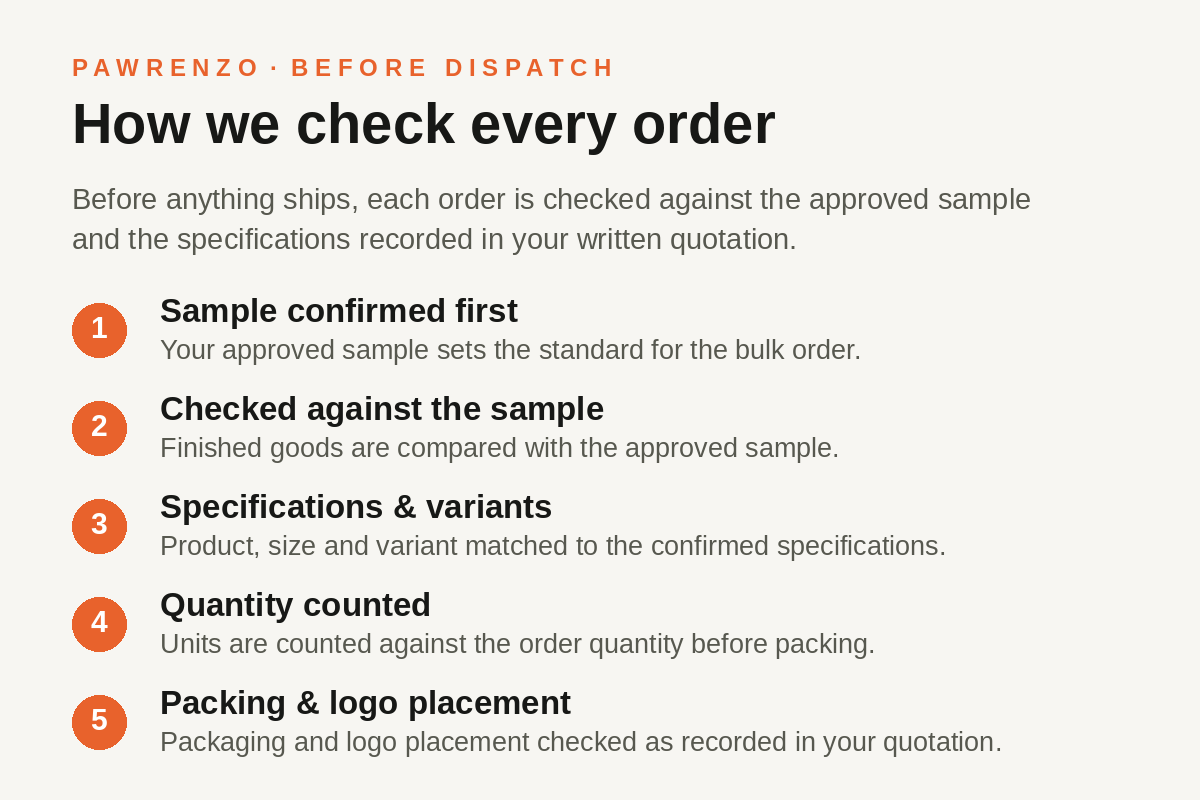
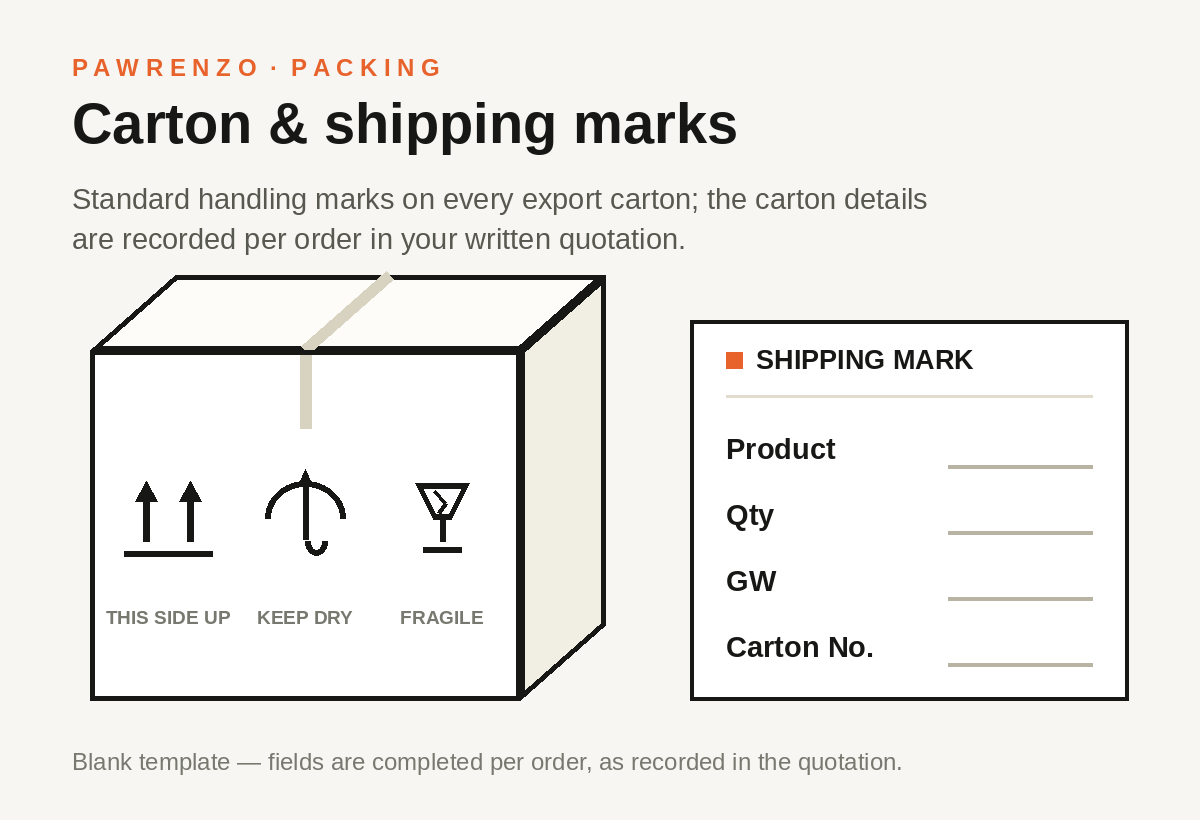
The Packing and Dispatch Area. Finally, walk to the loading or packing bay. Look at the master cartons being sealed. Ask the representative to point the camera at the shipping marks printed on the outside of the boxes (covering any confidential client brand names if necessary) and show how items are inner-packed in polybags to prevent moisture damage during sea or air transit.
| Audit Zone | What to Ask the Host to Show on Camera | What It Proves |
|---|---|---|
| Production Line | Active sewing, cutting, or assembly stations for pet items | Confirms real manufacturing capability vs. a residential office |
| Warehouse | Raw material racks and stacked finished-goods inventory | Shows material readiness and organized storage conditions |
| QC Station | Inspector testing zippers, stitching, and hardware | Verifies an actual inspection process exists before packing |
| Dispatch Area | Master cartons, inner polybags, and carton strapping | Confirms experience packing goods for international freight |
2. Which Documents and Data Points to Request (Without Getting Buried in Paperwork)
Many first-time importers make the mistake of asking for dozens of obscure certificates that can easily be photoshopped, while ignoring the foundational business documents that actually prove commercial legitimacy and freight readiness. Before wiring money, verify these four practical items:
Corporate Bank Account Matching the Proforma Invoice (PI). This is your number-one financial safeguard. The beneficiary name on the Proforma Invoice must be an official corporate entity — never a personal bank account in the name of an individual sales rep. Confirm that the company name on the business registration matches the corporate bank account receiving your T/T wire.
Itemized Proforma Invoice with Clear Incoterms. Your quote and PI should explicitly state the pricing basis — such as EXW (Ex Works) Guangzhou in USD — along with exact unit prices per tier (e.g., 100+ units), product SKU codes, colors, and materials. Ambiguous quotes lead to surprise fees later.
Verified Packaging Specifications (Carton Data). A real factory knows the physical footprint of its products. Before you commit to a bulk order, ask for the master carton dimensions (length × width × height), units per carton, net weight (NW), and gross weight (GW) for the styles you are ordering. If a supplier cannot tell you how many pet beds fit into a master carton or what that carton weighs, they do not handle their own packing.
Honest Material Breakdown. Instead of accepting vague buzzwords, ask for the exact material composition (such as Oxford cloth density, PP cotton filling, solid wood vs. particle board, or stainless steel vs. ABS plastic) so your customs broker can assign the correct HS codes for import clearance.
3. How to Cross-Verify During the Sample Stage
We covered the commercial math of ordering samples in our previous post, but during the factory-vetting phase, your sample box serves a second purpose: forensic cross-verification.
When your sample kit arrives at your store or warehouse, do not just look at the aesthetics. Use the physical samples to audit the factory’s honesty:
Hold the Sample Up on Your Video Call. During your live video audit, hold the physical sample you received in front of your webcam and ask the factory rep to grab the exact same SKU from their showroom or stock rack. Compare the hardware finish, webbing thickness, and fabric texture side by side in real time. This confirms the sample wasn’t bought from a random retail shop just to win your deposit.
Test the Stress Points. Pull hard on leash clasps, unzip carrier mesh panels repeatedly, and compress bed bolsters. Verify whether the construction matches the specification table on the supplier’s website.
Lock the “Golden Sample” Baseline. Once you approve the sample quality, take clear photos of the stitching, hardware, and measurements, and send them back to your account rep in writing: “We are approving SKU-X based on the exact material and stitching of the sample received on [Date]. Bulk production of 100 units must match this benchmark.”
4. Five Common Red Flags That Should Stop Your Wire Transfer
If you encounter any of the following behaviors while evaluating a pet-supplies supplier, pause negotiations immediately:
1. Requests to Wire Funds to a Personal Account. If the supplier asks you to send money via Western Union, personal PayPal, or a personal bank account because their “corporate account is under maintenance,” walk away immediately.
2. Refusal to Do a Live Video Call. Any excuse that prevents a 10-minute live smartphone walkthrough of the facility is a major warning sign.
3. Unverified “Too-Good-to-Be-True” Compliance Claims. Be cautious of suppliers who casually claim every single item in their catalog is “airline-approved,” “FDA food-grade,” or “indestructible” without backing documentation. Honest manufacturers state exact physical materials and dimensions rather than inventing compliance labels.
4. Bait-and-Switch on MOQs and Pricing Tiers. You inquire about a 100-piece order, and the supplier suddenly demands a 1,000-piece minimum per color or hikes the unit price by 40% right before issuing the invoice.
5. Refusal to Provide Packaging Weights for Freight Quotes. If a supplier demands your 100% deposit first and tells you they will “figure out the carton weights and shipping volume after production,” you risk getting trapped with inflated freight bills.
5. How Pawrenzo’s Factory-Direct Workflow Fits Your Vetting Checklist
At Pawrenzo (pawrenzo.com), we built our entire B2B wholesale operation specifically for overseas pet shop owners, online retailers, and regional distributors who want factory-direct pricing without the traditional sourcing blind spots.
Here is how our standard workflow aligns with every verification step above:
Factory-Direct, No Middlemen. We are a China source factory based in Guangzhou. Design, production, QC and export sit under one roof, so the documents you check and the samples you receive come straight from the source.
Accessible MOQ of 100 Pieces per Style. You do not need to lock up tens of thousands of dollars in a single SKU. We set a transparent MOQ of 100 pcs/style across our 55 live styles spanning 6 core categories: Sleep & Rest, Dine & Drink, Scratch & Climb, Play & Explore, Walk & Wear, and Carry & Travel. If you plan to sell under your own brand, our private label & OEM options cover the logo and packaging choices.
Transparent EXW Guangzhou Reference Pricing. Every product page on pawrenzo.com displays clear EXW Guangzhou (USD) wholesale pricing tiers (excluding freight), so you can calculate your exact product cost upfront without hidden middleman markups. See our worked example with real numbers for how EXW tier prices and a confirmed freight quote combine into a true landed cost.
100% Sample Fee Rebate on Your First Bulk Order. We never ask you to buy blind. You can order samples first to inspect our materials and workmanship firsthand — and 100% of your sample fee is credited back toward your first MOQ-100 wholesale order.
All-Inclusive Sample Box Pricing, Worldwide (Shipping & Duties Included to Your Door). We offer pre-configured Cat & Dog Sample Boxes at one fixed, all-inclusive price — US$50.00 per box, delivered anywhere in the world, including express shipping and customs duties:
| Ready-made sample box | Price — delivered worldwide | Sample fee credit |
|---|---|---|
| Cat Sample Box — 4 products | $50.00 | Credited in full against your first wholesale order |
| Dog Sample Box — 4 products | $50.00 | Credited in full against your first wholesale order |
You can also build your own sample set from any ready-made styles on the site: send us your list and we will reply with one payment link covering the goods plus shipping at cost. Contents and ordering for both options are on the Samples page.
Ready to Verify Us Yourself? Skip the guesswork. Browse our 56 wholesale styles at pawrenzo.com/products, or claim your all-in sample box today by emailing [email protected] or messaging us directly on WhatsApp.